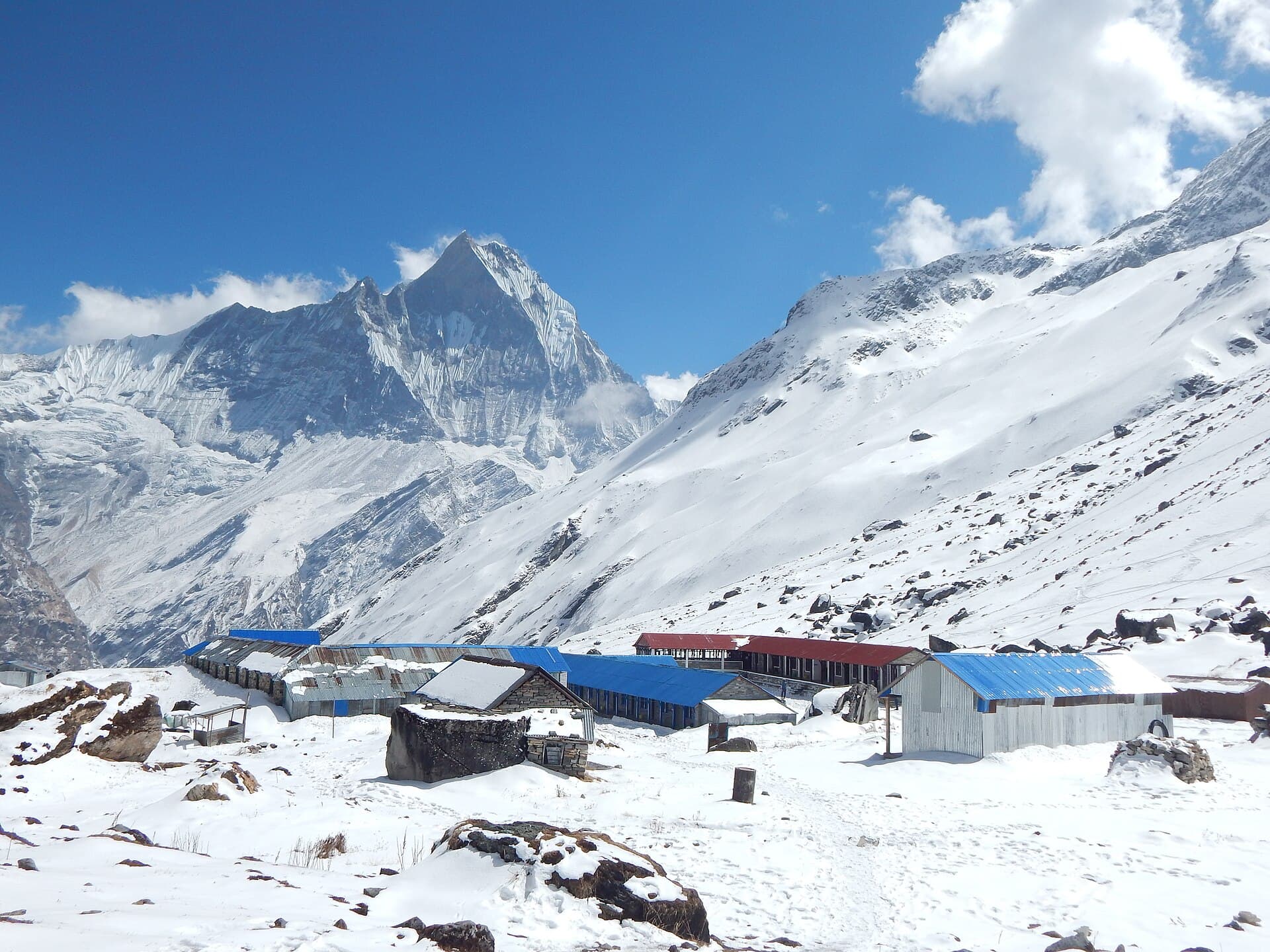
Annapurna Base Camp
Our first trek outside India - and we're saying so plainly.
Photo: Nepalkismat / Wikimedia Commons (CC BY-SA 4.0)
Challenging
Difficulty
110 km
Distance
10D / 9N
Duration
4,130 m / 13,550 ft
Peak Altitude
Summer, Post-Monsoon
Best Season
Why This Trek
Annapurna Base Camp
Every other trek in our catalogue sits somewhere in the Western Ghats or the Indian Himalaya. This one doesn't - it's our first step outside India, and we want to be upfront about what that means: no departures run yet, no confirmed pricing, and Nepal-side logistics (flights to Pokhara, permits, guide arrangements) still to be built. What draws us to it anyway is the Sanctuary itself - a trek that spends its final days walking into a bowl of the world's highest peaks, with ordinary teahouse villages the whole way there. We're listing it as a real, researched catalogue entry precisely because we intend to run it properly, not as a placeholder.
Before You Book
- Forest access may require a valid permit.
- Authorised guide support may be mandatory.
- Departure depends on current route availability.
- Weather and wildlife conditions may affect access.
- Route and timings can change for safety reasons.
- Camping is only offered where currently permitted.
- Government ID may be required for permit registration.
- Final confirmation is issued only after operational verification.
The Trail
The standard route climbs out of Nayapul through Birethanti and up toward Ghorepani, with an optional pre-dawn side trip to the Poon Hill viewpoint before continuing to Tadapani and Chhomrong - the last proper village before the trail narrows into the Modi Khola gorge. From Chhomrong the path drops and climbs repeatedly through Sinuwa, Bamboo and Dovan, dense forest giving way to bamboo and rhododendron, before opening onto the glacial approach past Machapuchare Base Camp to Annapurna Base Camp itself at 4,130m. The return largely retraces the gorge back to Jhinu Danda - with hot springs at the river - and out to Nayapul. Distances and daily stages below reflect commonly published route descriptions, not a route we've walked and confirmed ourselves yet.
- The Annapurna Sanctuary itself - a natural amphitheatre ringed by peaks over 7,000m, reachable only on foot
- Machapuchare ("Fishtail"), sacred and unclimbed, dominating the skyline for most of the route
- A single week that moves through rhododendron and bamboo forest, then alpine grassland, then glacier moraine
- Teahouse nights in Gurung and Magar villages - Ghandruk and Chhomrong among them - rather than tented camps
- An optional pre-dawn detour to Poon Hill for a wide sunrise view of the Annapurna and Dhaulagiri ranges
Itinerary
- 1
Pokhara to Nayapul, trek to Tikhedhunga
Drive from Pokhara to Nayapul and register at the Birethanti checkpoint, then follow the Modi Khola upstream through terraced fields to Tikhedhunga.
11 km · +470 m
- 2
Tikhedhunga to Ghorepani
The trek's steepest single climb - stone steps through Ulleri and on through rhododendron forest to Ghorepani, a ridge-top village with the first wide mountain views.
10 km · +1320 m
- 3
Poon Hill sunrise, then Ghorepani to Tadapani
A pre-dawn climb to the Poon Hill viewpoint for sunrise over the Annapurna and Dhaulagiri ranges, back to Ghorepani for breakfast, then on through forest to Tadapani.
10 km
- 4
Tadapani to Chhomrong
Descend through forest to the Kimrong Khola, then climb into Chhomrong, the last large village before the trail enters the Modi Khola gorge proper.
10 km
- 5
Chhomrong to Bamboo
A steep drop out of Chhomrong, then a long climb-and-descend through Sinuwa into bamboo and rhododendron forest to the camp at Bamboo.
10 km
- 6
Bamboo to Deurali
Climb steadily through Dovan and Himalaya, the forest thinning with altitude, to Deurali on the edge of the open glacial valley.
10 km · +900 m
- 7
Deurali to Annapurna Base Camp via Machapuchare Base Camp
The summit day - past Machapuchare Base Camp and across glacier moraine into the Annapurna Sanctuary itself, arriving at Annapurna Base Camp with peaks over 7,000m on every side.
8 km · +900 m
- 8
Annapurna Base Camp to Bamboo
A long descent back down the gorge, retracing the approach past Machapuchare Base Camp, Deurali and Himalaya to Bamboo.
17 km
- 9
Bamboo to Jhinu Danda
Descend to Chhomrong and down to Jhinu Danda, where natural hot springs by the river make for a welcome stop after a week of climbing.
10 km
- 10
Jhinu Danda to Nayapul, drive to Pokhara
A final descent to the roadhead at Nayapul, then a drive back to Pokhara to close the loop.
10 km
Who Is This Trek For?
Fitness level required: high. Group size runs 6–12 people. Age range: 14–55 years.
This route climbs to 4,130m over multiple consecutive days above 3,000m. Participants above 45 years, and anyone with a pre-existing heart, lung or blood-pressure condition, will need to share a valid medical fitness certificate before we can confirm a spot.
Inclusions & Exclusions
- Not yet finalised - see notice above
- International and domestic flights, and Nepal visa fees
- Travel to and from Pokhara
- Personal trekking gear (shoes, jacket, poles, sleeping bag liner, etc.)
- Any stay in Kathmandu or Pokhara before or after the trek
- Medical certificate fee, where applicable
What to Carry
- Valid passport with Nepal visa, and printed copies of permits
- Insulated, broken-in trekking shoes with good ankle support
- Down jacket and thermal layers - nights at Machapuchare Base Camp and Annapurna Base Camp are near freezing even in season
- Trekking poles for the steep stone-step sections around Ulleri
- Personal medication, a basic altitude-sickness plan, and a copy of any medical fitness certificate
- Sleeping bag liner - teahouse bedding varies in warmth
Safety
- Altitude sickness (AMS) is a real risk above 3,000m - ascent pace, hydration and rest days matter more than schedule
- Trek leader (once departures run) will carry a first-aid kit; teahouse network coverage is patchy above Chhomrong
- Anyone showing worsening AMS symptoms descends immediately - no summit push overrides this
- A licensed local guide is legally mandatory in the Annapurna Conservation Area and will lead all route and pace decisions
Permits
Two permits historically applied to this route. The TIMS Card (Trekkers' Information Management System) was discontinued for the Annapurna region in April 2023 and is no longer issued or checked here. The Annapurna Conservation Area Permit (ACAP) remains mandatory for every trekker and is checked at entry points including Birethanti and Chhomrong. Since April 2023, Nepal has also required every foreign trekker inside the Annapurna Conservation Area to be accompanied by a licensed guide from a registered trekking agency - independent, unguided trekking is no longer permitted on this route. We'll confirm exact permit costs and paperwork once our own Nepal-side logistics are in place.
Cancellation Policy
A ₹1,000 Booking Advance secures your booking request. Final confirmation is issued only after operational and permit verification. The advance is non-refundable and non-transferable, as it blocks your spot in the group.
If we cancel a trek due to weather, safety, or forest department restrictions, you get a full refund or a free reschedule.
Notes
This is SO[u]LE MATES' first international / Nepal catalogue entry - every other trek on the site is in India. We have not yet run a departure here, confirmed pricing, or built the logistics (flights to Pokhara, Nepal permits, guide partnerships) around it. Duration, distance and route details are drawn from commonly published Annapurna Base Camp itineraries and should be reconfirmed once our own team has walked the trail. Note also that the TIMS Card requirement widely referenced in older trekking guides was discontinued for the Annapurna region in April 2023 and replaced by a mandatory-guide rule - do not assume TIMS applies here without checking current ACAP guidance.
Sustainability
The Annapurna Conservation Area is Nepal's largest protected area and one of its most heavily trekked - we plan to keep groups small, stick to teahouses already part of the local economy, and carry out what we carry in, once we're running departures here.